Saturday, September 11, 2010

Defining the Quiet Novel

Every now and then I've seen the term "quiet novel." Not all that often, because I don't read huge numbers of book reviews or much literary criticism, but from time to time people will describe a book thus. I never thought about it--it seemed like an ordinary enough way of referring to a book, just as one might call a book "lively" or "rumbustious."
Awhile ago an agent commented to me that quiet novels aren't selling well these days. I was a little dubious about that because only a given percentage of the novel-reading population prefers books that are filled with adventure, excitement, and car chases, and the book to which the agent referred didn't strike me as terribly quiet. It featured sex, drugs, rock-and-roll, tears, accusations, theft, and theater. I granted, however, that agents are more in touch with the publishing world than I am these days. In any case, I still took the term "quiet novels" as a simple descriptor.
But then my friend Betty referred to "two very quiet 'portrait' novels" that she felt were similar in tone to one of my projects. More references to quietness? (Let's not get into "portrait" since presumably any reasonably reflective novel revolving around one character could be considered a portrait.) I began to wonder whether "quiet novel" was a genre rather than a mere subjective description. I did a Google search.
Most uses of the term that came up seemed subjective, although fairly congruent with one another.
An Amazon customer review of Anita Shreve's Sea Glass begins "Anita Shreve's latest book, "Sea Glass," is a quiet novel that deals with the universal themes of life, love, loss, hope, beauty, tragedy and death." The fairly in-depth, very positive review ends by saying that the book has "no great surprises and no great suspense. It doesn't delve too deeply into the minds and hearts of the characters involved, but then, we don't always want something that's earthshaking."
In "The Virtue of Quiet: "Colm Tóibín’s Brooklyn," Dan Hartland writes, "Colm Tóibín’s Brooklyn is a quiet novel. [...] very quiet." He mentions, on the whole very favorably, "the book’s peculiarities: a focus on the internal, a modesty of style and of ambition, and a dry, sardonic humour." He notes that while the book's moderation and passivity mirror those of the protagonist, this unity is intentional and the book is, in fact, full of incident. So it's not a book where nothing happens and everything revolves around the protagonist's navel.
Hilari Bell, discussing suitable and less suitable ways of writing of novel climaxes, refers to books in which "The climax doesn't match the story. You see this most commonly in a quiet novel about tangled relationships...that ends with a car crash (or a kidnapping, or a natural disaster) and the protagonist suddenly finds herself struggling for survival."
Lynne Griffin's blog post "Literary Lingo Recap," which nicely defines various current buzzwords used by agents, simply defines a "quiet novel" as a literary novel, especially one without a strong plot. (She defines literary novels as usually being more character-driven than plot-driven, and more about the writing than the story, which is a common definition of literary novels in texts geared toward commercial fiction. There are, however, many books fitting that description that more "literary" readers would simply call mainstream novels.) While I think that overall Griffin's definitions are useful, this one just doesn't cut it for me. Lots of literary novels would never be called quiet, including some that aren't terribly strong on plot. A picaresque literary novel, for instance, is unlikely to be either quiet or (by definition) plot-driven. Literary novels cover a lot of ground, after all. There are literary novels with strong plots, nonexistent plots; with experimental narration and with traditional narration; with deep characterization and without much focus on character; the main thing is that a literary novel is not a commercial novel, although occasionally one may belong, to some extent, to one of the genres typical of commercial fiction, and of course every now and then a literary novel is a commercial success. Should we distinguish between a genre called the literary novel (which might be mainly quiet novels) and what's known as literature (Moby Dick, Tristram Shandy, Wuthering Heights) when we're not using the term literature to mean sales brochures ("I'll leave you some littachur") or academic writing ("the literature")?
The blog post Shantaram & the idea of a Noisy Novel mentions the quiet novel somewhat as a foil to noisiness. The blogger opens with a conversation had with a novelist friend: "We were talking about what it was that publishers might be wanting at the moment, and she told me that the days of the quiet novel were largely over." The blogger continues, "I take the quiet novel to mean a beautifully written, often short-ish narrative in which not much happens. Stylism is the quiet novel's main event: plotting is barely perceptible, characterisation is but a ripple on the surface on the writer's prose. The focus is often on transactions of a personal, intimate nature between a small group of people living within a softly-spoken coo-ee of each other." (She then discusses noisiness and hyperrealism, mainly in the context of the Australian novel.) This prompts some good reader comments on quiet versus noisy, and the blogger's response that "Jane Austen and Jeanette W[interson] weren't exactly what I had in mind as examples of the quiet novel, tho the quiet novel has links with a tradition of quietism focusing on the personal, domestic, intimate life etc. However, both JA and JW feature strong characterisation and elements of social or aesthetic analysis. Also -- most of JA's novels *are* strongly plotted. [...] Whereas the quiet novel, at worst, is often more like a collection of loosely-related scenes." After a few more reader comments, she says "I think the point is just simply to do with strong vs weak narrativisation, and whether it's time for a revival of strong narrative, which is possibly more allied with pulp fiction and film at present." So for this well-read and intelligent blogger, a quiet novel is likely to be a dull and poorly plotted thing that by definition doesn't really grab the reader. This is not someone who equates "quiet novel" with "literary novel;" rather, she wants lively, strongly plotted novels that are better written than Shantaram, a book about which she has mixed feelings.
Confused by so many different, even if somewhat related, uses of the term "quiet novel," I asked Betty what she thought. Was it a genre or a subjective evaluation? What was her personal understanding of the term? Even if it wasn't going to be clear exactly what everyone else might mean, at least I could find out what Betty meant in relation to my own project. Betty responds:
Quiet novels to me are those written with emotional and intellectual constraint. A quiet novel keeps the reader on an even keel because the style tends toward calmness. Events may be very dramatic, but they're described with restrained prose so that the reader isn't feeling emotionally pulled. Stimulating and challenging questions may arise, but because they're written with understatement, the reader doesn't feel stirred up intellectually. In quiet novel, I as a reader, feel more like an observer. This doesn't mean I'm not drawn into the story or that I don't emotionally connect with the characters, but rather that I'm not experiencing it with great dramatic pulls. I feel compassion for characters, but the writing doesn't make my pulse race or my body twitch. My heart doesn't break although I understand the heartbreak the character is feeling.

Betty cites some comments on specific quiet novels: "[Peter] Taylor as always writes in the most measured, calm manner, so that the surprises and the humbling human understanding he so effortlessly throws in seem barely to ruffle the surface." (Kirkus Review)
"A Summons to Memphis is like a leisurely port wine sipped slowly and with pleasure beneath a blackjack oak." (The Philadelphia Inquirer)
"Serious, beautiful and affecting, what makes Stoner so impressive is the contained intensity the author and character share." (Irving Howe) ". . .[T]he passion of the writing [in Stoner is] masked by coolness and clarity of intelligence." (John McGahern)
Betty concludes:
I hope that gives you some idea of what I mean by a quiet novel. It's no doubt true that unless you're already a well established literary personage, then getting quiet novels published today is likely more difficult than getting "less restrained" work accepted for publication. Wolf Hall, for example, pushes and pulls the reader emotionally and intellectually. There's nothing subtle about Mantel's writing. She writes with visceral descriptions that can make you ache from the pain she's inflicted on a character. The opening scene is extremely dramatic, steeped in physical cruelty. This, I think, is what the publishing world is saying the public wants.
I, of course, don't think that's necessarily so.
There are likely many variations on how to understand what quiet means, but I hope this gives you a better idea of what I was referring to.

And yes, that gives me a better idea what at least one reader has in mind. Whether Betty will continue to think the tale is quiet, and whether others will think so, remains unknown.

Monday, September 6, 2010

More on Novels and the World of Work

Awhile back I posted some ruminations on whether recent literary fiction has much to say about work. It wasn't my own observation that literary fiction tends to bypass work, and I hadn't previously thought much about it, but my literary friends are showing a tendency to disagree with the notion that literary fiction does not deal with work. Betty Dietz, for example, writes:
I'm not so sure that work has fallen out of favor in novels over the past twenty years. I think the opposite is true. I think that in literature now more characters are engaged in specific jobs and that their employment is used as theme, for character development or, at the least, as an important point of reference on which the story is built. Off the top of my head and from the stack of most recently read novels, I've thought of several books that use work as an integral part of their character and/or thematic development. In Stoner, John Williams immerses his protagonists in academia (the University of Missouri in Columbia). A Summons to Memphis, by Peter Taylor, is the story about a rare book collector and editor who is the son of a lawyer, and the brother of two sisters who are real estate managers. In Summertime, by J.M. Coetzee, the story is told by a biographer researching a book about the writer John Coetzee who has died--it's a fictional autobiography. The researcher interviews five people and each of these people have specific jobs that are relevant to the telling of the story. Coetzee's Disgrace is about an academic who loses his job because of a scandal involving one of his students. The Stain by Phillip Roth is also about an academic. Wolf Hall by Hilary Mantel is about Thomas Cromwell, a lawyer who worked his way up from being the son of a blacksmith to being the chief adviser to Henry VIII. The Conservationist by Nadine Gordimer is about a businessman who spends his weekends and holidays being a gentleman farmer in South Africa. A Long, Long Way by Sebastian Barry drags us through the trenches with a WWI soldier.

I could think of more, but that's enough. Work, I think, is an important component of contemporary literature[...]

It must be confessed that I have not read a single one of these novels; I am hoping that I'll have somewhat more time to read fiction in the coming years, given that graduate school is over. The fact that Betty has read these is a recommendation in itself. In any case, perhaps the essay upon which I originally commented drew on an idiosyncratic pool of novels. Further thoughts from readers are encouraged.

Saturday, September 4, 2010

And Where Did They Go?

Most of my home gardening this summer has involved pulling weeds in the back yard and attempting to keep the container plants watered, but today's temperatures miraculously dipped to the 50s and 60s, so I was able to spend several hours in the yard without either heatstroke or death by mosquitos.
I had the pleasure of finding two of these in the front garden:

Since they were eating a vine rather than milkweed, I assumed they were Swallowtail caterpillars rather than Monarchs, and since there are numerous types of Swallowtail, that's not impossible, but this Wikipedia photo of a Monarch caterpillar looks more like my guests than any of the Swallowtail photos. The plant, they were devouring, honeyvine (Cynanchum laeve), is apparently one of the few non-milkweeds Monarchs will eat.

I was going to photograph my striped tenants in their full glory, but when I returned with the camera an hour or so later, they were gone. I hope they were merely napping out of sight and not eaten by birds.
Speaking of birds, a hummingbird came by around the same time to check out the blossoms on a coleus I had just repotted. The other day I saw a bright yellow bird of finch-like shape in the back yard (I have no idea what it was).
And there are many types of butterfly and bee visible in the yard at any given time.

Thursday, August 19, 2010

Still Not at all Dead

Can it be this long since anything new has gone onto the blog? Shocking, just shocking. Well, the house has been bought and moved into, more or less, although very few of the books have been unpacked and there are various projects to be undertaken before the upstairs gets much use. The usual summer trip to California has been made, and will result in about 160 boxes plus miscellaneous furniture being shipped here, probably arriving just in time for school. Ah well, life is a project.

Sunday, June 27, 2010

Garden Tour

My new neighborhood does a biannual garden tour, so as I didn't yet have keys to the house, I spent my Saturday looking at gardens and introducing myself to yet more neighbors. Most of the gardens are relatively small--from a few feet wide to about the size of my future back yard--but considerable care and imagination went into them.


The tour included, for an extra $5, a restful tea break at the local mansion. And when I say mansion, it genuinely is one, but a mansion rehabbed just like everything else in the neighborhood. We have tiny cottages, medium-sized houses, and a mansion or two.


It's been hinted that I should prepare my garden for the next tour. Since I'll have two years to get ready, I suppose I might manage it. We'll see.

Sunday, June 20, 2010

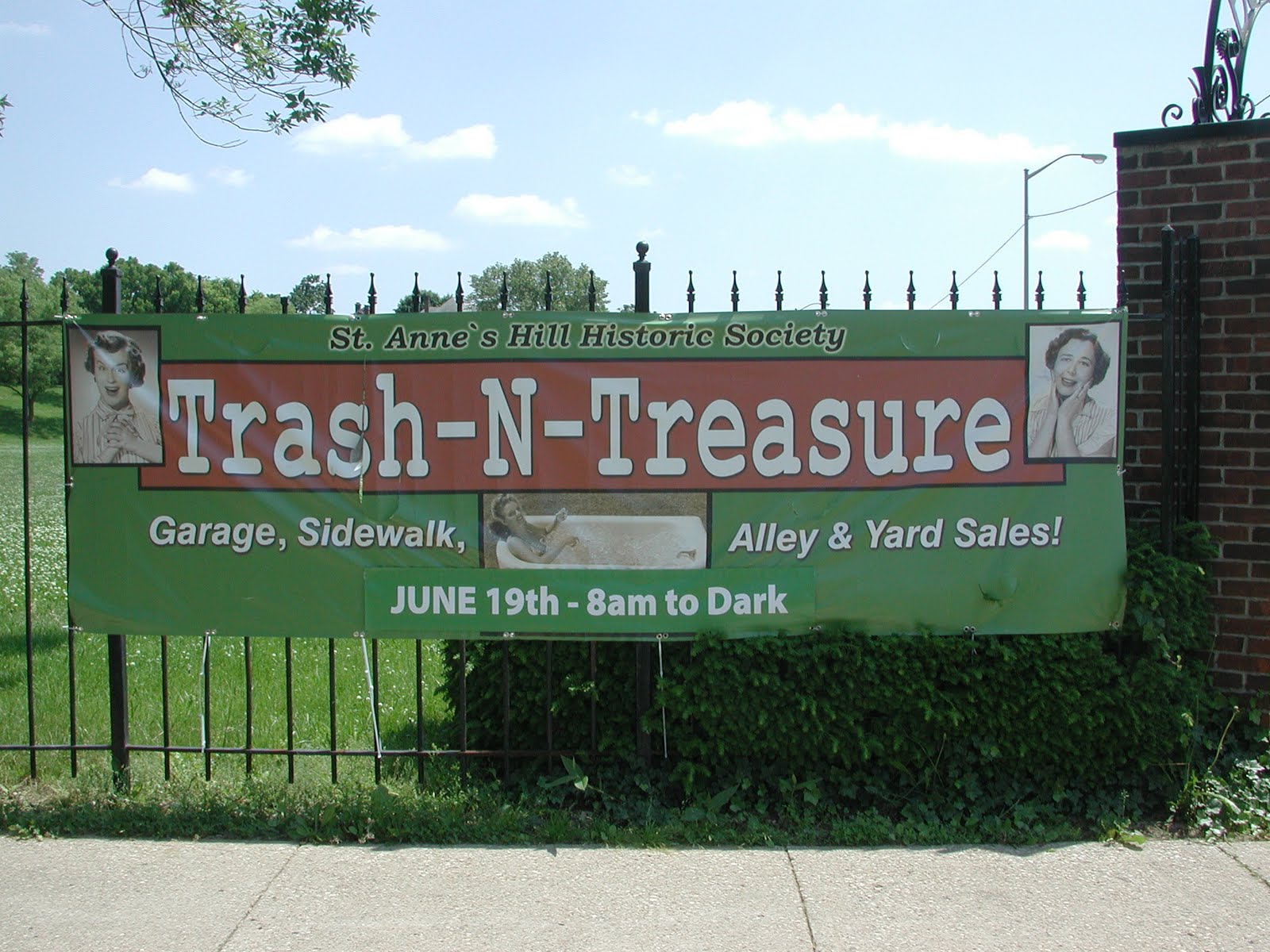
St. Anne's Hill Trash-N-Treasure


On Thursday I closed on my new house, and Saturday was the annual neighborhood sale in my new area. St. Anne's Hill is fairly famous for the quality of its neighborhood sale, so I was eager to see what I might find for the new house. My current neighborhood had had its sale a couple of weeks earlier, and while I hadn't seen much activity there (and had also promised to take a colleague to the Cincinnati airport), I had nonetheless managed to pick up an antique table and chair, some wooden cigar boxes, and a stack of 1950s magazines for well under $150. Who knew what wonders might await me at the much larger St. Anne's sale?
I was over at St. Anne's, coffee in hand, at the very start of the sale, but unfortunately it had begun to rain while I was picking up the coffee, so for the first hour or so everyone was tarping their wares. That is, everyone except those selling out of a garage, porch, or living room. But most of what I saw to start out was under a tarp. This made it tricky. I didn't see anything I wanted in the first hour or so.
On the other hand, it was also my mission to introduce myself to my new neighbors. The historic districts have very active neighborhood associations, so it made sense to make myself known. This part of the morning went very well. Everyone was welcoming, and many of them were familiar with my house. Some of them had even already heard of me. I heard (not for the first time, but it's a good story) all about how the man who renovated the house back in the early 1980s ordered wallpaper specially from England for it. It's probably still something of a challenge to order wallpaper from England, but let's keep in mind that there was no email or internet then. The wallpaper in my downstairs is part of the city's historic house lore. The house is also one that people are very fond of. Even the various home inspectors and roofers went into ecstasies over it, which I am sure they cannot bring themselves to do over every house they see.
As the weather began to clear, I began to find things I actually wanted. Some had already sold, but mostly not. I could also have gotten a beautiful 1920s stove-and-oven for free had I had a means of carting it away (the owner said it was free to whoever could carry it away first)--I don't actually need a stove-and-oven, but I would have used it as a decorative piece in the dining room (the white Hoosier cabinet there is departing). However, I knew I had no way of carting it, and another enthusiast, who has a store on 3rd and thinks he can fix the recently defunct oven, arrived with a truck while I was chatting with the owner.
I am not entirely sure what-all I got, as it is nearly all sitting in the car, but the haul included two mirrors, one large rug, a Czech perfume bottle by my favorite glass manufacturer (whose name I can never recall), a lamp, a batch of Celtic and jazz CDs, seven plants, a wicker chair, some tins, and a sack of excellent homemade tamales. I met up with three members of my department in the course of my wanderings, and they too acquired exciting items. We were very pleased with ourselves by the time we parted in the early afternoon.

Saturday, June 19, 2010

Yellow Springs Street Fair

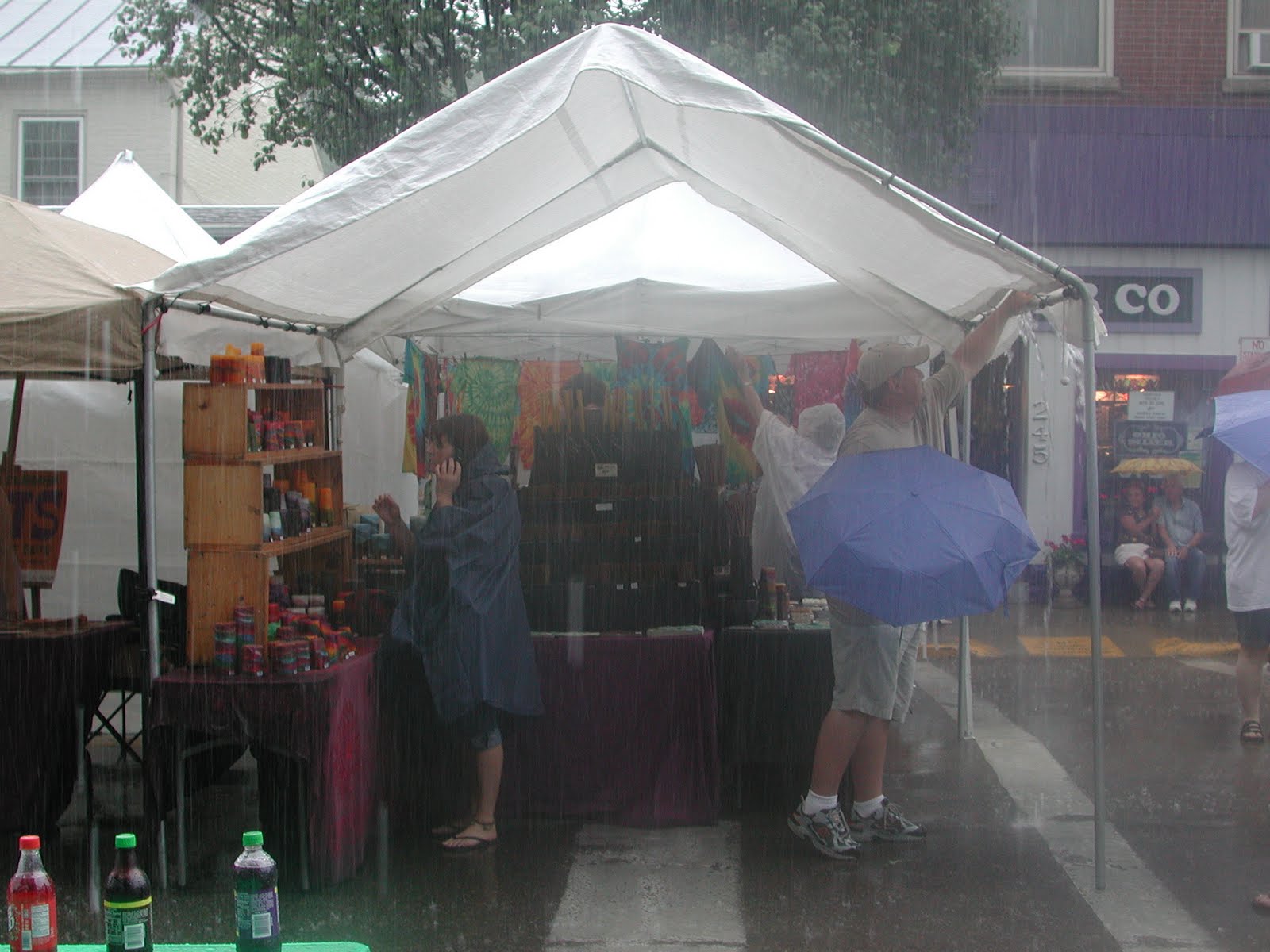
Last week's Yellow Springs Street Fair experienced considerable rain early in the day, but fortunately things dried off by noon or so. It was similar today at the Saint Anne's Hill neighborhood sale.